

In the Himalayan mountains of Bhutan, women in the village of Goenpa Kabab weave intricate silk Kishuthara dresses on backstrap looms, a skill passed down through generations in a Buddhist, matriarchal community. Sherab Tshomo, a 41-year-old artisan, has been perfecting this craft since age eight, which involves dyeing raw silk with local plants and using traditional methods to create detailed patterns. Despite the high value of these garments within Bhutan and abroad, many women artisans struggle to access international markets, including the global fashion industry, to showcase their artistry and heritage.
Economic Development

Global trade is set to grow 7% in 2025, driven by East Asia, Africa and manufacturing, reaching a record $35 trillion despite persistent imbalances and rising geopolitical fragmentation.

Young people remain at the heart of the fight against corruption. Deeply affected by its consequences, they are uniquely positioned to uphold ethical standards in their communities and challenge corruption at every level. Building on the 2024 campaign launched on International Anti-Corruption Day (9 December), the 2025 campaign continues to highlight the role of young guardians of integrity as advocates, raising awareness about corruption. This year’s effort features young leaders sharing insights on links between organised crime and corruption and the key role of AI and emerging technologies.

The international civil aviation sector stands at a pivotal moment of growth and transformation. By 2050, the industry is expected to serve over 12 billion passengers annually and transport significantly larger volumes of cargo, underscoring its vital role in global connectivity and economic development. The International Civil Aviation Day seeks to highlight the importance of worldwide air transport to the social and economic progress of Member States, as well as ICAO’s unique role in fostering cooperation among governments to achieve a truly global rapid transit network that serves all humanity.

An UNCTAD report shows prolonged military operations and restrictions have devastated the Palestinian economy, erasing two decades of progress, with Gaza’s GDP per capita at $161 and the entire population facing multidimensional poverty.

Sustainable transport is linked to resilient infrastructure development, food security, economic growth, trade, global supply chains, health promotion, energy efficiency, and climate action. It is also reflected in several Sustainable Development Goals (SDG) targets and recognized as an enabler for achieving many of the goals. World Sustainable Transport Day (26 November) marks the start of the UN Decade of Sustainable Transport (2026–2035), creating an opportunity to raise awareness of transport’s vital role in advancing the SDGs and to mobilize solutions, resources, and partnerships globally.

The World Bank’s IDA21 programme is working to help people in the world’s poorest countries by using $100 billion in financial commitments to create jobs, improve services, and protect the planet.

Rural women are the innovators, leaders and changemakers at the core of our planet’s food systems. That’s why supporting them is essential to building a sustainable future. In honour of the International Day of Rural Women, we’re celebrating their vital contributions. In a new episode of IFAD’s Farms.Food.Future podcast, we explore how empowering women through training, access to resources, and leadership opportunities creates stronger rural communities and leads to measurable improvements in income, food security, and resilience.

In Brazil's Pajeú region, marked by inequality and historical struggles like the cangaço movement- groups of bandits who challenged the entrenched power of large landowners-, women played vital roles in resistance and community resilience despite being marginalized. Environmental challenges, especially water scarcity due to the degraded Pajeú river basin, compounded their difficulties. To combat these issues, the Community Association of Women from Bom Sucesso, with support from the GEF Small Grants Programme and UNDP, launched a project to empower women through sustainable agriculture and political participation. They constructed cisterns for rainwater harvesting, promoting female leadership and agroecological practices in their semi-arid environment.

Züleyha Ceylan, a 22-year-old in Düzce, Türkiye, drives her blue truck to tend to her beehives. Adorned in a canary-yellow beekeeping suit, she calmly inspects her hives, finding joy and energy in the buzzing bees. Despite skepticism from her community about her choice, Züleyha’s parents supported her passion for beekeeping. With high local demand for honey and minimal land required, she produced 100 kilograms of honey this year, selling it through friends and social media. Züleyha aims to expand her business to include products like royal jelly and create jobs for others, bolstered by training from the Food and Agricultural Organization (FAO).
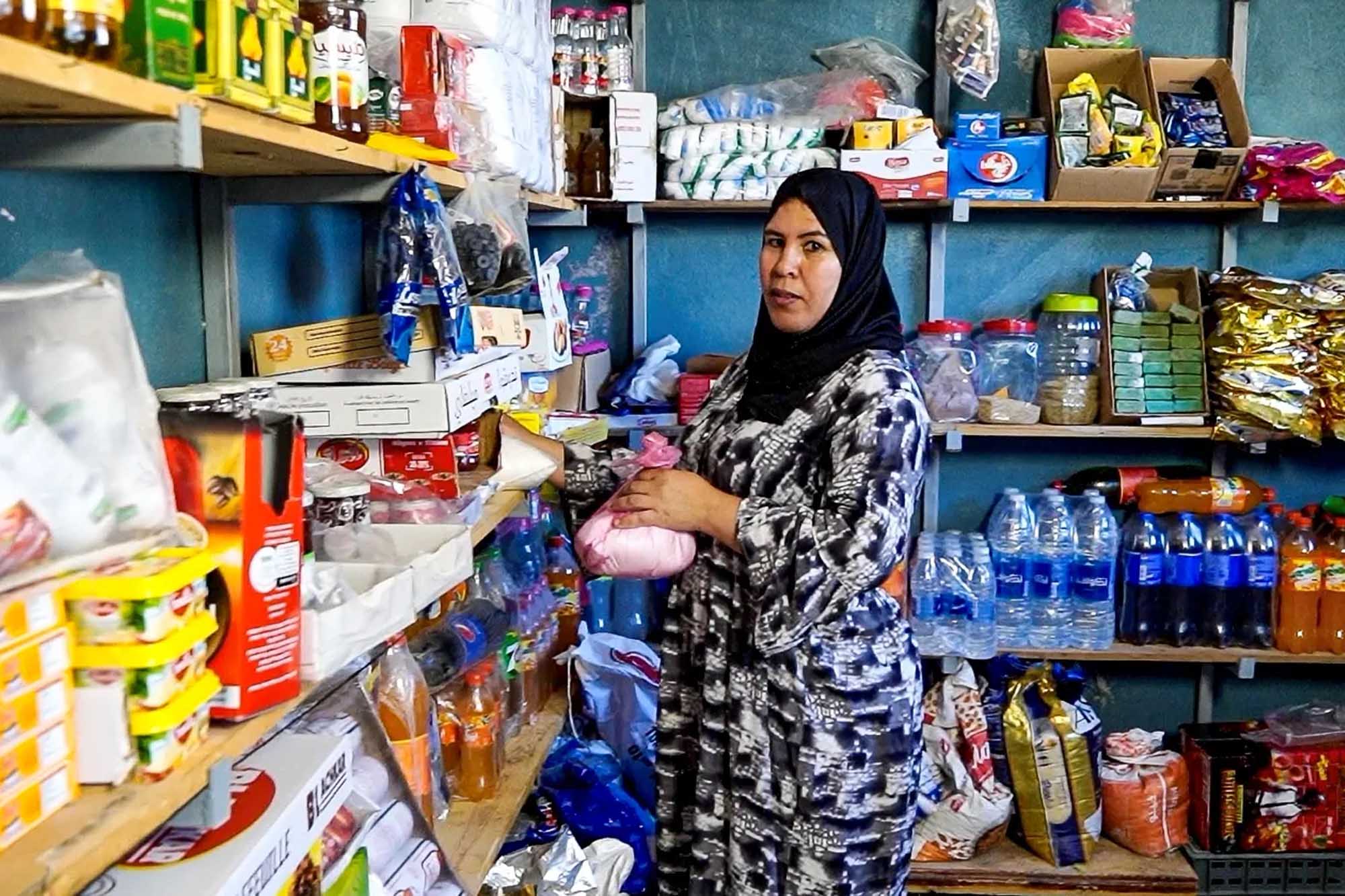
Fatima Laanieg has always been drawn to hands-on work. After taking care of her home and children, she sought to contribute financially. Four years ago, she became a seasonal agricultural worker in Spain, which went well. Fatima dreamed of starting her own business but lacked resources. In 2022, she joined WAFIRA, an International Labour Organization (ILO) programme for women run by Morocco’s National Agency for the Promotion of Employment and Skills, where she expressed her desire to open a grocery shop. With training and support from her husband, she gained confidence. Her dream is to expand her small shop into a supermarket and inspire her son to learn the trade. Fatima is committed to growing her project step by step.

Six months after a devastating earthquake hit central Myanmar, particularly Mandalay, the area shows signs of destruction with collapsed structures and a need for recovery. The country, already facing civil war and political unrest, struggled further with the added impact of the disaster on poverty and livelihoods. In response, community groups and international partners rallied together. With support from the United Nations Development Programme (UNDP) and contributions from nations like Korea and Japan, a comprehensive plan was implemented quickly to clear debris, provide temporary shelters, and ensure access to clean water, marking a significant step in the early recovery process.

Developing economies currently face a significant investment shortfall, requiring about 5% of global GDP annually to meet development goals, with low-income countries needing 8%. Since the 2008 financial crisis, investment growth in these regions has slowed dramatically, particularly in private investment and foreign direct investment (FDI). Nevertheless, new World Bank research indicates that investment miracles are possible, as evidenced by 115 investment accelerations over seven decades that doubled GDP growth and significantly reduced poverty. However, such accelerations have become increasingly rare since the 2000s, affected by global conditions and domestic policy challenges.
For 60 years, United Nations Development Programme has partnered with governments and communities to reduce inequalities, create jobs, support crisis recovery, and promote inclusive, sustainable development worldwide.

Being in debt can be burdensome, and similarly, our obligations to Earth are growing. We are depleting the planet's resources through deforestation, food waste, overfishing, and fossil fuel extraction at an alarming rate. This year, Earth Overshoot Day, which indicates when we surpass the Earth's annual resource replenishment ability, fell on July 24. At our current consumption rate, we require 1.75 planets to support our lifestyles. Since 1971, when we were within planetary limits, our consumption patterns have increasingly disregarded the needs of future generations.